
You’ve validated a phone number, confirmed it’s mobile and active — but when you dial it, you reach the wrong carrier or get an unexpected result. The culprit is often number porting. Understanding what porting is and how to detect it can save your campaigns from costly routing errors and compliance gaps.
In this guide, we’ll explain what number porting is, why it matters for marketers and developers, and how to detect ported numbers using a phone carrier lookup API.
What is Number Porting?
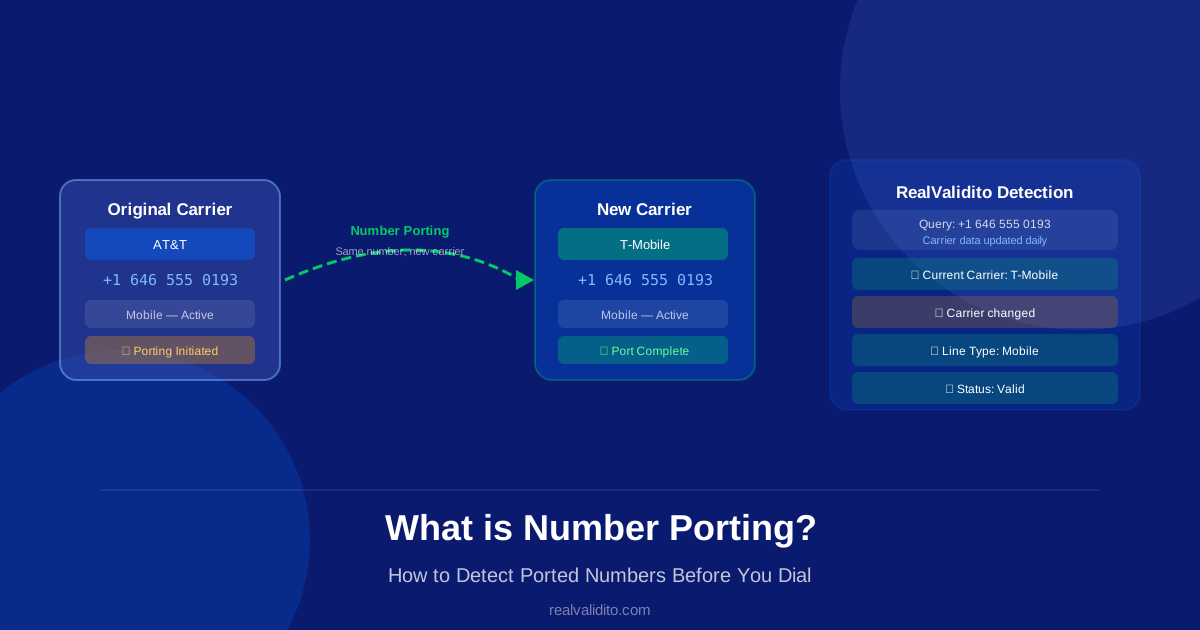
Number porting is the process of transferring a phone number from one carrier to another while keeping the same number. In the US and Canada, the FCC and CRTC guarantee consumers the right to port their number when switching carriers — a regulation known as Local Number Portability (LNP).
For example, a customer who switches from AT&T to T-Mobile can keep their existing phone number. From the outside, the number looks identical — but the underlying carrier, network routing, and sometimes the line type have all changed.
Types of Number Porting
| Port Type | Description | Example |
|---|---|---|
| Carrier port | Same line type, different carrier | AT&T mobile to T-Mobile mobile |
| Landline to mobile port | Line type changes from landline to mobile | Verizon landline to T-Mobile mobile |
| Mobile to VoIP port | Number moves to a VoIP provider | AT&T mobile to Google Voice |
| Geographic port | Number retains old area code in new region | NYC area code, now used in LA |
The landline-to-mobile port is particularly important for SMS marketers — a number that was previously unreachable via text may now accept SMS after porting.
Why Ported Numbers Matter for Marketers
Carrier routing accuracy
If your system routes calls or messages based on carrier information stored in your CRM, ported numbers will be misrouted. A number recorded as AT&T six months ago may now be on T-Mobile — sending it through AT&T-specific routing rules causes delivery failures.
TCPA compliance
Under the TCPA, consent comes from the person who has the number. Porting does not change who owns the number, so consent stays valid when a customer moves to a new carrier. The real risk is a reassigned number — a disconnected number given to a new person. A carrier lookup cannot detect reassignment; check the FCC Reassigned Numbers Database for that.
Line type changes
A landline ported to a mobile carrier becomes SMS-capable. Conversely, a mobile number ported to a VoIP provider may lose reliable SMS delivery. Without detecting the port, your line type data becomes stale. Read our guide on What is a Landline Number for more on line type filtering.
Fraud detection
Fraudsters frequently port numbers to VoIP providers to mask their identity or bypass caller ID systems. A number that has been recently ported to a VoIP provider — especially a cheap or obscure one — is a common fraud signal worth flagging in your validation pipeline. See our guide on How to Detect VoIP Numbers for more detail.
How to Detect Ported Numbers
The only reliable way to detect porting is through a carrier lookup API that uses frequently updated carrier data (RealValidito Phone Lookup data is updated daily) rather than old records. Here’s what to look for in the API response:
Current carrier
Phone Lookup returns the current carrier and line type, so a ported number shows its new carrier.
Current carrier vs. original carrier
The API returns the current carrier — the carrier actually serving the number right now. If this differs from what you have stored in your CRM, the number has been ported. Use this to update your records and re-route accordingly.
Line type after porting
After porting, the line type may have changed. Always use the current line type from the API response — never rely on historical data. Our Phone Carrier Lookup API guide covers this in more detail.
How Often Should You Check for Ported Numbers?
Number porting happens continuously — industry estimates put it at approximately 35-40 million numbers ported in the US every year. That’s roughly 3 million per month, or about 100,000 per day. On a list of 50,000 contacts, you can typically expect 500-1,000 numbers to be ported in any given month.
- Before every campaign send — for high-value or compliance-sensitive lists
- Every 60-90 days — for general marketing lists
- At point of entry — validate every new number as it’s added to your database
- After a data purchase — always validate third-party lists before use
Porting and the Do Not Call Registry
Porting does not affect DNC registration: the FTC keeps registrations by number, not by carrier, so the number stays on the DNC list whichever carrier serves it.
Always run DNC scrubbing as a separate step from porting detection. A number can be ported and still be DNC-registered — you need both checks. Learn more in our guide: What is the Do Not Call Registry?
Practical Example: Updating CRM Carrier Data
- Export your contact list with stored carrier data
- Run the list through RealValidito’s bulk phone lookup
- Compare the returned carrier with your stored carrier for each number
- Flag mismatches as ported numbers
- Update your CRM with the current carrier and line type
- Re-route as needed based on the changes
Frequently Asked Questions
How long does number porting take?
In the US, simple wireless-to-wireless ports typically complete within 4 hours. Landline ports can take 2-5 business days. During the porting window, the number may be intermittently unreachable.
Can I detect a port in progress?
Some carrier lookup APIs return a “porting in progress” status. RealValidito returns the current confirmed carrier — if a port is mid-process, the result reflects the most recent confirmed state in carrier records.
Does porting affect a number’s validity?
No — a ported number remains valid and active. Porting does not change the number itself, only the carrier serving it. The number continues to receive calls and (if mobile) SMS messages.
What is a geographic port?
A geographic port occurs when a number with a specific area code is ported and the owner relocates. The number keeps its original area code even though the user is now in a different region. This means area codes are no longer reliable indicators of location — another reason to use a lookup API rather than area code-based routing.
Conclusion
Number porting is a constant reality in the US and Canadian phone networks. Ignoring it leads to routing errors, compliance gaps, stale carrier data, and missed fraud signals. By detecting ported numbers with a carrier lookup API (data updated daily), you keep your contact data accurate and support your outreach compliance.
RealValidito’s Phone Lookup API returns the current carrier (ported numbers show their new carrier), line type, and Valid/Invalid status in a single call — giving you everything you need to maintain accurate contact data at scale.
Start with 1,000 free Phone credits and 100 free DNC credits — no credit card required.